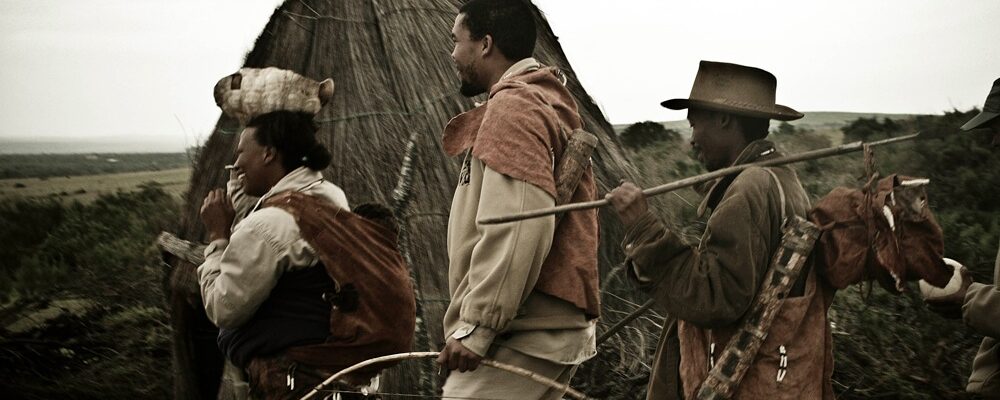
‘In the end we will conserve only what we love, love only what we understand, and understand only what we are taught.’ Baba Dioum – Senegalese Philosopher.
It is the only combined San project in South Africa, where communities find
representation and acceptance. The name means ‘Waterhole’; begun eleven years ago by
anthropologist Michael and his wife Bets, a venture of love and self-denial.
In collaboration with !Khwa ttu is Civair, providing a 30minute chopper ride which dips
over sand, sea and Robin Island, to our landing at the !Khwa ttu centre up the Cape West
Coast.
Shortly after landing and an introduction to our hosts, we are seated to an organic lunch
of waterblommetjie soup, Eland Pie, Lavender shortbread and other local delicacies. As
we dine, our host shares with us not only the history of the San and their dispersed plight,
but the team’s vision of preserving existing languages as well as remembering those that
have died.
Essentially, Michael explains that surviving San leaders had come to realise that the
media had created an image of the San people which needed to be both reclaimed and
retold, this time rooted in truth and honesty. So together with the Swiss Ubuntu
Foundation, a dilapidated wheat farm of 850hectars (70km outside of Cape Town) was
bought, and for seven years, developed. !Khwa ttu, both an NPO and NGO, sought
independence as a project, promising equal access and representation to all who could
claim San heritage.
Four years ago !Khwa ttu was officially launched: a restaurant, conference rooms,
accommodation for 50 beds (both in the bush camp and guest house) and the highlight; a
training centre. Regarding the latter, trainees enjoy nine months of tourism tuition,
spending three days in class and three participating in practical work. Culminating these
nine months, the idea is that these San descendents graduate with diplomas, bright CV’s;
and a future as tourism guides.
In the dry sunlight, we are then introduced to Andre Vaalbooi, our guide to the world of
San heritage, folklore, legend and plants.
In the surrounding bush, looking nondescript and thorny, Andre brings different plants to
life: their uses, antidotes and poisons. We had stepped into a chemist, scanning the isles
of nature. Wooden signs indicated medicinal categories, as ‘Women’s Health’ presented
shrubs to induce childbirth, whilst another sort of leaf when ground, was said to ease the
pain of labour. Nothing was forgotten, nothing overlooked.
Turning the path corner, we step lightly into a recreated bush-camp; with seven huts, a
lady seated in the dust. Original San; beads, loin cloth and sparks of fire. So whilst the
woman clicked in San, Andre interpreted and explained how clothing had been made
from animal hide and how it would have differentiated for the single and married
individual. With a loin cloth strapped over his own trousers, Andre showed how the
material around the buttocks area would have been pulled when one was about to be
seated, and tucked when needing to run. We smiled.
Then Fire. A man, Andre explains, would have been prohibited from marrying until such
time as he could start a fire. So he showed how two dry sticks would be rubbed together,
and how a tiny plume of smoke was then supposed to rise. ‘So maybe that’s why I’m not
married’, he complained. The task appeared almost impossible.
After a sip of buchu tea as we congregated around what would have been the campfire, it
was back to the main camp, a quick peruse of the documentary style photographic
exhibition.
Too soon though, we were heading back for Cape Town.
The day hadn’t been spent pouring over books or reading archive material of what was.
Rather it was retold and related in the mother-tongue of Africa: oral tradition. Andre had
been our equivalent of a granny sitting at the fire place, teaching the young deep into the
night about life, lest she be taken from it without warning, leaving those left behind
vulnerable for lack of knowledge.
Here we stood having paid homage to what would have been the ancestors, their stillness
now finding a voice in Andre and people like him; the trainees we had met. How
privileged we had been to peer into that world through porthole of !Khwa ttu. Had we
had time, I would have loved to sleep in the bush camp. I‘ll be back soon enough though.