Growing up, Switzerland was the countryside and landscape to which everything unique and quaint was compared. ‘Look at that mountain, we ‘maze well be in the Alps’. Swiss beauty thus formed idealistically in my girlhood imagination, and finally the opportunity presented herself like a flower in spring.
We arrive and stand outside the Hotel Suisse, Geneva. Its freeze alert…as we acclimatise to the drastic change: a difference in temperature of about 30C. Later in the day, as snow begins to fall in sub-zero temperatures I map my way to the International Museum of the Reformation.
At the epicentre of the Calvinist Reformation, much of Geneva’s architecture and statues pay tribute to the founding fathers of this movement, the most profound being the Wall of the Reformation. Here, images of John Knox, Jean Calvin and other revolutionary counterparts stare back in stone, imposing in their size and magnitude (dependent on their respective influence).
Stepping just outside the Museum; you then turn a corner onto the steps of the St. Pierre Cathedral, built between 1150AD and 1230AD…when political and economic boundaries were but forests and hills of Edelweiss. In this century, the eleventh, stone masons would travel throughout Europe in search of a cathedral such as this to help construct, under the guidance of a ‘master builder’.
As an assurance of payment then, these masons would leave a protruding piece of stone un-chiselled, and only upon payment would they lob it off. And there, in the corner of this gothic cathedral, a fistful of stone spoke of a mason who went unpaid, a world of powerful clergy and humble artisans. Thus evidence described in Follett’s ‘The Pillars of the Earth’ lives, and your heart beats as you realise that this other, peasant world surely did exist.
Carouge: the unexplored of Geneva. It’s quaint with markets, gardens and clusters of old Sardinian women on street corners, pitying the madman who walks past chatting to himself. I’m told he’s been like that ever since he lost his wife.
Then around a corner, there is the Rue St Joseph. A street lined with artists of perfection; the hat-maker, clock-maker, chocolatier…the baker. Free-standing bells ring as we open Jean Kaze’s door, where he stands smoking over a clock destined for London. He is the genius of the trade, yet simple. Kazes stares back at us, posing graciously as we shroud him in camera light.
The United Nations and Red Cross Headquarters; aesthetically they seem grey and devoid of importance…and yet we still stand and marvel alongside our Chinese brothers. Outside the double barricaded UN building is a sculpture, an enormous chair with a missing leg (apparently a reference to landmines and the loss of human limbs suffered by those in war-torn countries).
We wave Geneva goodbye and board the train destined for German canton, to the city of Lucerne. Accompanying our train ride (more significantly) is Franz Czeisler Tihany, Latvian Clown- President of the “Monde du Cirque”, world circus. We are introduced solely because the Swiss Train Travel System has decided to launch its first circus-themed train.
‘You’ve got to have fun. Not enough people have fun in life’, Tihany says. His one shoe is red, the other green. He wears baggy pants, a gypsy earring and shoulders a reversible multi-coloured coat. I think he is remarkably likable.
Three stations along, an elderly couple step into our carriage and Franz greets both with sociable ease. Then he introduces his friend as Andy Warhol’s screen printer. Pop art, glaringimages from the 50’s, I feel overwhelmed for a few seconds in the presence of what seems to be the upper echelons of creative genius; world-renowned individuals who just ‘happen’ to cross paths (serendipitously) on Swiss carriages.
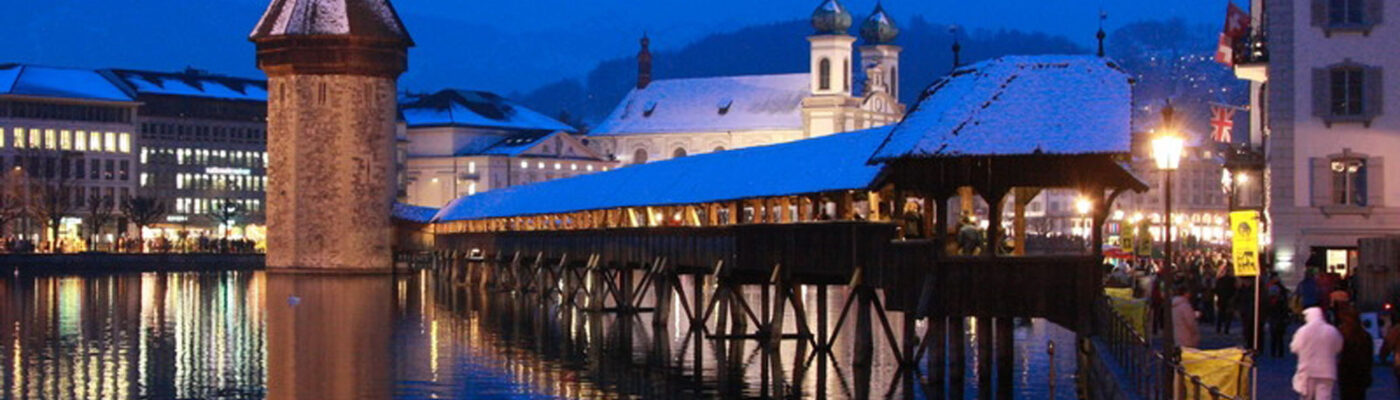
We step off the train. Adrenalin. Music blasts the station while witches come sprinting past, in tow is ridiculous looking children. Lucerne is in the throws of a week long carnival, where stereotyped Swiss precision blends into a melting pot of alcohol, colour and music. Celebrating its’ annual winter festival, the aim is to chase away the ‘spirits of winter’ through drumming, trumpets and tunes from competing bands. Home-made costumes prance forth and families dress according to a theme of choice: witches, chickens and the solar system. We too look monstrous, as we drape what look like furs of war over baggy green pantaloons.
In twighlight hours we dine at the Stadtkeller, and here the festivities continue as various bands take turns to play their way through the restaurant before blasting their way back onto the street. Wrinkled hands hold up copious amounts of beer in ‘prost’ and vociferous German happiness. On the side, stray band-members feed us hard liquor from a bottle, likely having originated in the trenches of WWII. Love it.
Day following, it’s to the peaks off Mount Titlis (awkward to pronounce, yet every part illustrious). From the centre of Lucerne it’s by train to the base of the mountain range, where the track climbs ever-higher as the mist clears with rays of sunlight. In winter, Lucerne and lower-lying regions are often grey. In the Alpine mountains though, you ascend beyond the clouds, where beauty is uncovered by pure light.
From Engelberg (the entrance to the ski resort) we board a mountain rail to Trübsee. Here we tour the hotel bar, jump on a snow tube and skip through the Igloo hotel. I watch as people sip their liqueurs and hot chocolates in a -14C nip, over-looking distant mountains; the sunlight enhancing snow white.
Fun-extreme…I nap the train ride back to Lucerne. Arriving at dinner that evening, our group babbles through that day’s events in broken English (as most originate from former ‘Eastern block’ countries). Bless, but it’s a linguistic circus. The dinning room, my Russian counter-part informs me, is ‘very smart’, which she likes.
Outside, the festival rages through its final night. Like everything Swiss, the Carnival is steeped in history; with rumours of its ongoing annual presence since 1685. Local bands from surrounding villages march their last in the finale Monstercourse with group names such as the Abfallpolizei (rubbish police)and Ruussfrosch (space frogs).
The final countdown and an early morning tour shunt(s) us down narrow streets recovering from previous nocturne’s festivities. Down one such street in Lucerne’s city-centre, our attention is directed to a unique pharmacy (built in the early 1800’s). Inscribed onto the wall above the doorway is a quote: ‘There is No Cure for Love’. Clearly, the pharmacist had been a busy man, with no time to dispense pills for post-love depression. Thus l’amor had been a passion of the times, as voices and songs of Eros had spread their Bohemian ideals from the Moulin Rouge…to Swiss neighbours.
As a farewell toast though to beautiful Switzerland, I’m booked for a lunch cruise along Lake Lucerne. With a window seat, villages sail past while my hot soup is served. Later that afternoon, I’m sad to leave.
The Switzerland of my imagination thus has faded, replaced by sweet experience, Lindt chocolate and the voices of history. Few things compare to having ones knowledge of stories, phrases or moments met with concrete explanation: evidence that language, behaviour and life exist in the cosmic context of those gone before. Even thoughts, world views and attitudes root themselves in time and place, and oh the privilege when the knot between past and present is tied.
Switzerland is akin to a fine wine, extra-matured to be drunk with slow appreciation. It’s physically touching the last guillotine used during the French Revolution, John Knox peering at you from a stony wall and witches scampering past with a beer in hand.