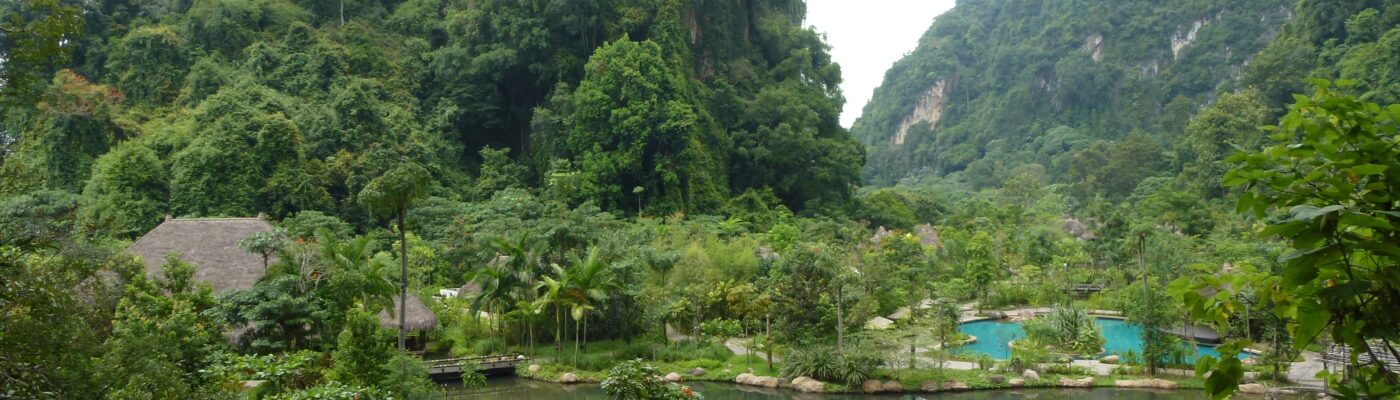
Playing on the Equator (just be sure to wear shoes).
For about two weeks after my return, one of the only answers I could give about my trip was that it was hot. It’s the truth, and if you were to look at a map you would notice that Malaysiais approximately two degrees north of the Equator. Humid too: which seemed to stunt. My. Thoughts…and promote a general sense of laziness, especially when required to walk anywhere. It’s surprising how a physical feeling or sensation will be the one that your memory records as having the most significance. Now though, sitting in an air-conditioned office, Malaysia is no longer hot. A more apt definition would be ‘tropically wonderful’.
Separated by geography, but not words.
Malaysia is divided into two separate islands. The one to the south (just above the Kingdom of Borneo) is famous for scuba diving, island resorts and beach activities. The northern island though is where we spent our days, many of them in Kuala Lumpur (the locals pronounce this by rolling and then flattening the R) and then the outer lying areas of Malacca and Penang.
Malaysia still has a monarchy. Politically, it is divided into thirteen states and three federal territories scattered over the two land masses mentioned above namely: Peninsula Malaysia (sometimes referred to as West Malaysia) and Malaysia Borneo (East Malaysia), both of which are separated by the South China Sea. Semantically speaking though, it’s said that the latter terms are preferred, apparently so as to avoid association with the separation that was experienced in the (old) East and West Germany.
On this particular note, Malaysians work hard at (and pride themselves in) the promotion of the unity and equality of a heterogeneous society, and the evidence of this lies not only in the utterances of their intent but so too in their actions. Watch an Indian (Malay) and Chinese (Malay) communicate. Despite cultural and physical differences, they will laugh at the same jokes, and share in the same joys. On the whole though, they are an extremely peaceful people who over the centuries have influenced, changed and embraced one-another’s cultures, and cooking techniques.
Baba-nyonya
Any Malayan dish which incorporates a Chinese style of cooking or ingredient, for example, is now known as a baba-nyonya dish, ‘baba-nyonya’ actually being the term used to refer to ‘the descendants of the late 15th and 16th-century Chinese immigrants to the Indonesian archipelago of Nusantara during the Colonial era’. And whilst the intent of the Chinese was never to conquer Malaysian cities (as the British, Dutch, Japanese and many others had succeeded in doing both before and after their arrival) it was simply to settle, co-habit and finally, without malicious (or other) intent, naturally to influence. Those of Chinese descent though often became prominent figures within the communities they chose to settle in.
Cheong Fatt: at age 70, he found Love.
One example of such an immigrant was Cheong Fatt, a Chinese businessman and politician who had left Dabu (in the Guangdong Province of South China) soon after the Second Opium War. After beginning his career as a water-carrier in Jakarta, Indonesia, he then made the calculated business decision to marry into a wealthy family, soon after which he established a trading company with the ‘help of his father-in-law’.
After expanding his business once (to Medan), he expanded again and finally found himself on the Northern Malaysian island of Penang in 1886, which is where he decided to settle and build one of many homes. This particular one was recognised by UNESCO to be the ‘Most Excellent’ Heritage Conservation site in the year 2000. Also referred to as the Blue Mansion, it is more commonly referred to as the Cheong Fatt Tze Mansion.
By this stage, Fatt owned three ships and oversaw trade between the towns of Penang and Sumatra. After many awards and recognitions, he was finally dubbed ’the Rockefeller of the East’. This powerful association to the ‘rich man of the West’ however applied not only to his business prowess but also to his personal life; because by the time he died Fatt not only had numerous residences and an entire trading empire, but also eight wives. What is not commonly known though is that he had actually married mostly for convenience, and to establish good connections with both the rich and prominent in society. At 70 though, it’s said that he finally fell in love: with a 17 year old. He married her, and she remained his favorite until his death in 1916. So if you ever get to visit the Cheong Fatt Tze Mansion, look out for black and white pictures of a skinny, Chinese looking girl, staring somberly back at the lens.
Malaysia’s own Helen Zille…
Skipping two centuries ahead, we arrive at the story of yet another influential individual of Chinese descent. Her name is Dato’ Sri Dr. Ng Yen Yen, and her appointment as current Minister of Tourism has been heralded as a milestone for the countries politics, as she is the first Malaysian Chinese woman to ever attain a cabinet position.
Dato’ Sri Dr. Ng Yen Yen is a lively, charismatic extrovert much like Helen Zille. Not to be intimidated by the name though: the words Dato’ Sri simplyrefer to a title given by the Ruler on any individual deemed to be the most deserving recipient. As for Dr: she has a background in medicine. So we’ll henceforth refer to her as Ng Yen Yen.
She was the honorary guest at one of the pre-Grand Prix functions we were invited to. Instead of sitting in her chair though, this short lady danced, captivated the audience by chastising the Russians ever so slightly for their (general) alcohol intake (thereby creating a slight stir), and giving us facts about her country as if she had written the Malaysian section of Wikipedia. She was an inspiration partly due though to the fact that in South Africa, we often expect very little from our politicians. Ok, apart from the dancing perhaps. And unlike in Africa (where most characters could have starred in the hit classic: The Untouchables) there was an air of transparency about her, as she opened herself up not only to praise but also criticism.
Sometime during her speech, Ng Yen Yen spoke about the fact that Malaysia is duty free bar five products namely: cars, glass, alcohol and cigarettes and chocolate. One of the main reasons why foreign cars were taxed, she said, was to protect the locally produced Petronas. So at the end of the evening, one of the journalists happened to be standing outside as she waved goodbye and true to her word, she was driving local. I’ve since come to the conclusion that if I were a politician and if she had been wearing feathers, I would like to think that I would have plucked one from her hat.
The Petronas Towers: the Amazing Race.
There are the Petronas towers, and then there is the F1 Car. We’ll start with the towers first. Today, they are the tallest twin towers in the world, a status symbol not only of Kuala Lumpur, but of Malaysia. They are stately, and seem to bring a Western, first world feel to the sprawl that is much of the city. You look up, and it’s as if you find inspiration: to work harder and dream bigger. I’m not making this up though. At the top, there is a plaque which reads: ‘As an internationally recognised national landmark, the Petronas twin towers are a national pride to the people of Malaysia. They symbolise the courage, ingenuity, initiative and determination, energy, confidence, optimism, advancement and zest of a nation that will bring worldwide recognition and respect to all Malaysian’. In one word, I would call it Patriotism.
The towers are 452 metres high and although they’re popularly referred to as the ‘Petronas Towers’, I met a journalist from Borneo who mentioned that one of these actually belongs to the king of Borneo (who is known to be somewhat of a greedy hoarder).
Joining the two towers is a 170 metre bridge, which we got to walk along in an extremely controlled fashion, and together with tight security. Over lunch a little later, we were told that the bridge itself was actually constructed in 33hours. The story goes that the Japanese were commissioned to build the one tower and the South Koreans the other. Both are competitive nations, but it was said that the nation who completed their tower first would be the one to ‘win’ the job of erecting the bridge. I was glad to have found this out later. I’m not sure how I would have felt knowing that I was walking on 33hours worth of labour; it’s less than a full day’s work.
The Malaysian Grand Prix (the other amazing race).
Then, you have the Petronas car racing in the Malaysian Grand Prix, alongside Ferrari, Red Bull, McLaren and others. This is apparently the cheapest of all the races in the F1 season, making tickets worthwhile not only for the locals, but so too for the international visitor: a melting pot of nationalities. To put this into perspective, our tickets cost 600 Ringgit each (and as I write, the exchange rate is 2.5 Rand to one Ringgit).
Finding our seats about an hour after we had arrived, the feel was similar to that of an athletics stadium. The total length of the track was 5.5 kilometres long, and we had been booked into the stand facing the first (exciting) bend, which meant that we could only see about 5% of the total track space. To fill us in on how the race was progressing in other corners though, a live feed was sent straight through to a big screen in the distance, which I’m guessing is what viewers back home would have been watching. In that way therefore, we had the benefit of the bigger picture. Following the lead car was also a chopper, and so we always knew where the number one car was located on the track. Needless to say, we never felt out the loop. Cringe-Pun.
To test the track, the drivers were given a trail run and as they curved into the bend just in front of our stand; the deep sound of the engines enveloped me and my adrenalin seemed to peak in excitement. To catch those first moments, I zoomed to focus my lens on the cars, and waited for perfect moments as they sped into the frame of my shot.
Just before the race began however, tropical droplets had started to fall as thunder loomed on the horizon and lighting lit up dark clouds in sporadic flashes. Soon after lap five therefore, people started booing and I soon realised why. Officials had decided to send the safety car out ahead of the drivers, disallowing them to pass thereby moderating their speed. Soon afterwards the race was stopped, at which point the normal crowd entertainment kicked in featuring: the wave of the Mexican. I decided to chat to a few Indonesians I’d just met, and so the 50 minutes or so passed by almost unnoticed.
Ferrari: Red and Racy- it won the Day.
It was only after the break that Ferrari’s Fernando Alonso took the lead, followed by (what was probably a two second gap) the Mexican Sergio Perez, who held his position, thereby ensuring that he too got to be sprayed with a little (celebratory) champagne.
Ferrari’s win though caught everyone by surprise, including the Spanish born Alonso, who according to Sports Network in Malaysia (humbly) credited his team for the success, saying that ’the team deserves this victory’. So besides champagne to mark their success, the Italian anthem boomed across the arena first (and at this point my pride actually knew no bounds) followed closely by the Spanish (oh well, loving is sharing).
Watching this moment of victory, one of the journalists next to me mentioned that Ferrari apparently never choose an Italian to drive, as this is considered ‘very bad luck’, he said. I laughed, knowing all about the trivialities of luck and superstition within the Italian culture. In fact when I was young, we would have to lock up our black cat whenever our great aunt came for dinner, because if she even laid eyes on Tossy, it was believed that her luck and good fortune would suddenly end; as if a giant hand were holding a stop watch over her small, grey head. Poor lady. She suffered from the belief of quite a few other anomalies which included: walking under a ladder and opening an umbrella in the house. These are just the ones I remember. Back to the point though, I was slightly surprised that superstition had found itself all the way to the Malaysian Grand Prix, instead of simply remaining in the village where it originated. I digress.
So as I turned my back on the scene, the sun hovered orange in the dusk of a 7 o’clock evening, and food vendors tried desperately to sell the last of their hotdogs at 50% off the original race price. It was pure elation.
As hinted at above, we were scheduled to leave Kuala Lumpur the next morning in the direction of Malacca(148 km south east of KL). But before delving straight into the history of this UNESCO world heritage site, I think I’ll focus on something trivial as the bird’s nest that I bought at one of the (informal) markets.
The Nest
It’s a (female) weaver’s nest and now, it resides on the veranda at home. I saw it, and I asked our guide to translate. I needed to know firstly: if it was real (‘yes’) and secondly, if it contained any diseases (‘no’). I tend to take people at their word, and so I bargained it down to 20 Ringgit and was told that I shouldn’t squash it. This nest though became a bit of an experiment: would it make the journey home? So after transporting it from one hotel room to another, I had to check it in hand-luggage (wherever we flew), carry it all over Bangkok for an entire day, and was surprised when Nest made it through the Asian borders every time (you know what Thai security can be like). So though it remains uninhabited, it will forever be associated with this town.
More important than the nest’s migration to the Cape though, was the migration of the people group we now refer to as Cape Malay.
Malacca: the original Bo Kaap
Malacca had been tossed back and forth like a ping pong ball from the Portuguese in 1511, to the Dutch in 1641 and then the British in 1826 (and hence its unique heritage, much of which is still evident today). It was during the period of Dutch rule and the trade of the Dutch East Indian Company then that South East Asians (including those from Malacca) started filtering down to Cape Town, which had by this stage been identified as a ‘resupply station for ships travelling between Europe and Asia’. Those who were exiled had either been enslaved, or relocated due to their having been identified as Muslim dissidents, makers of chaos and unrest within the Dutch ranks (this mainly being the case in Indonesia). And this is how Islam was first introduced to the shores of Cape Town.
Besides her people, one of the most obvious similarities between Malacca and Bo Kaap (also declared a UNESCO world heritage site in 2004) is the colour. There is vibrant paint everywhere, and as cruise up one of the Strait of Malacca, bold images (painted at the back of the houses and shops facing the riverbank) flash back at you, garish and graffiti-like.
Around the time when Cheong Fatt was dubbed ‘rocker-feller of the East’, this river was dubbed the ‘Venice of the East’, thought to be suitably chosen for the place where ‘traders from the East and West met’. It’s interesting though how so many Asian (and African) landmarks or achievements are given a Western context, as if they’re still being colonised by some invisible narrative sub-text and popular culture. Back at the river though, we sail under a bridge built to resemble Rialto in Venice. It’s a complete replica.
Penang: Gulliver would’ve loved this place.
Finally we arrived at Penang Island, and as we crossed the bridge from the mainland, lightning lit up dark clouds. I looked up tall blocks of flats; their windows bright against the skyline, and felt far from home. Maybe it was just the knowledge of being on an island, separated from the mainland that I had just become so familiar with, which made me feel vulnerable. Maybe it was the thunderstorm. Either way, it felt like anything could happen. Like a tornado could suddenly peal itself out of the sky without warning. More accurate to the story though would be a tsunami. Whish is exactly what happened here over the Christmas of ‘04.
Fauzi Binmolto Jacob (and the tsunami)
I took a photo of a plaque of remembrance in the Spice Garden (not far from our incredibly cool Hardrock Hotel) and listened to many renditions of the story. The most interesting though came from a guy called Fauzi Binmolto Jacob. He had been commissioned to guide our two-hour jungle trekking expedition through the Penang National Park (located on the North- Western tip of the Island).
Of Indian descent, Fauzi is the son of a fisherman but in truth, he is (actually) the Malaysian Marlborough man and still lives in the local village near town. As a child, his father had taught him everything he knew of the land, animals and the seasons and now, he dispensed just a small sum of that information onto our eager ears. So as we trekked, he crafted ‘Robin-hood-looking hats’, and would stop to point out both poisons and perfumes amidst non-descript looking foliage.
On Boxing Day (2004), Fauzi had been working as a manager at a hotel in Penang. Sometime during the early afternoon, he noticed the strange direction of the wind, and the atmospheric conditions (which I cannot really recall and describe thanks to my limited knowledge of the earth). Basically, what I’m trying to say is that he knew how to ‘read the signs’, which if you look at utube footage of the event must have been difficult to do (especially considering the fact that it was a sunny, perfectly looking day). Fauzi’s intuition and power of observation though was so keen (almost animal like) that he predicted the wave just hours before it struck. So at the moment of realisation, he called in all the swimmers and life-guards from the sea, got everyone onto higher ground and in essence, saved dozens of lives. Eight years later, there is still not only physical evidence of the tsunami but also a fair amount of reference to the event in conversation, possibly because it was the first time that a disaster of this magnitude had ever struck the island.
To put Malaysia’s total loss into perspective though, it should also be mentioned that only (and I use the word reverently) 68 people died, as opposed to the total 300 000 who perished all along the coastline of the Indian Ocean. According to a study done a year later by Frederick W. Colbourne (of Emporia State University), Malaysia (and Penang Island specifically) was actually saved due to a variety of factors which included not only the ‘configuration and bathymetry’ of the coastline, but also the ‘low density of settlement’ in the worst affected areas. And so in comparison to a country like Indonesia, Malaysia is (and was) ever rarely affected by natural disasters (a point also mentioned by Dato’ Sri Dr. Ng Yen Yen) and therefore probably worth the note. So for those (disaster weary, law-abiding) travellers, you can be assured that Malaysia is one of the safest destinations, probably safer than a tea-garden in Constantia on a balmy Sunday afternoon.
With a Wave, and Thanks…
I think it would be best to end with our final afternoon, spent in the Penang National Park. After a long, tropical trek through forest and dense bush, we caught a boat ride down the East side of the island, landing at a secluded but expansive stretch of beach. By this stage, I had abandoned my shoes and with little else but our dirty clothes to link us to (Western) civilization, we sat under a make-shift thatch construction to a chicken, fish and beef braai. We ate with bare fingers in silence and afterwards, after diving into the shallow shoreline (still with my clothes on), I realised how carefree the day had been. And as I dried in the warm wind, and laughed as someone sat and snapped the hammock behind me, I marveled at Asia. A place so different from our own: as vast as Africa; diverse as the Avatar landscape and culturally rich as Europe: It is a land truly worth the exploration, and it’s with thanks and gratitude to: Thai Airways and Tourism Malaysia, that I end, and drone into your subconscious (very much unlike the Zoolander soundtrack!) GO. TO. MALAYSIA. (Ps: did I mention that I met the president? He lives:)
The end!