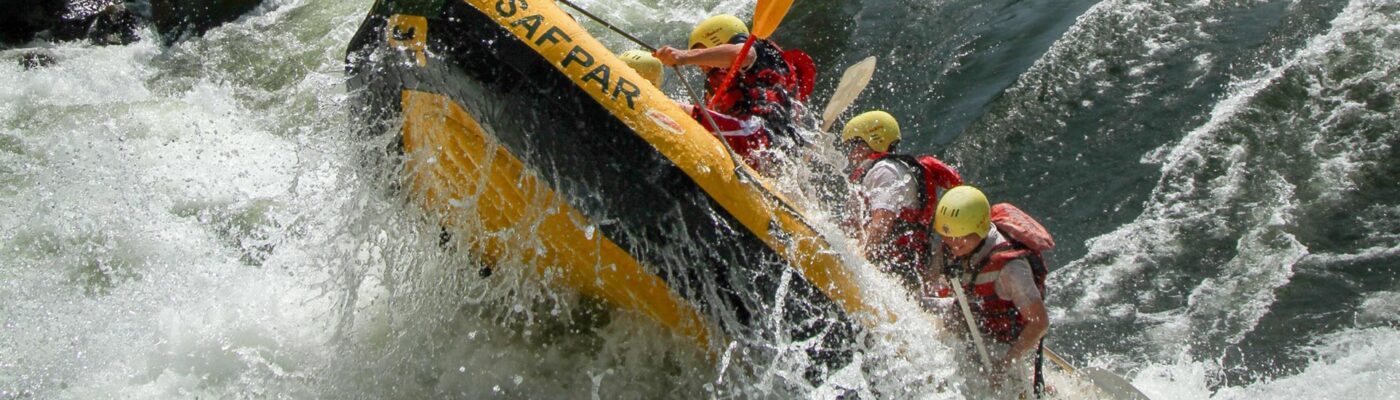
As I clung onto the side of the boat, I thought the journalist from Getaway magazine had done (literally) just that and was trapped beneath the boat (which had tilted to a 90degree angle and was now stuck between a rock and the mighty waters of the Zambezi). The rest of us clung to the raft like monkeys on a swaying branch, and I remember thinking that if I let go, things may not end so well.
Tembo (our guide) yelled at us to shift our weight. I’ve never seen such wide eyes. We all looked at one another for reassurance, but our faces only reflected terror (at least min did). Finally, we repositioned the raft and piled in, ducking at the command to ‘get down’, which saw us safely down the second part of the rapid. Meanwhile, Getaway had been found (clinging to the end of the raft) and was hoisted back in.
Our introduction to the three day rafting trip down the Zambezi with SAFPAR (Safari Par Excellence) had been an amusing one. After hiking down into the Batoka Gorge, six of us (including guide) jumped into a yellow, inflatable raft and soon we were practicing our forward and backward paddles. Floating in a peaceful corner isolated by the sideways flow of the current rushing down from rapid one, it gave our newly created ‘team’ time to develop a few skills. High above us, against the afternoon darkness of an African sky, human shadows swung 111m off the Victoria Falls Bridge. We were in the Mecca of Adventure, surrounded by the mighty walls of the Batoka Gorge which were so beautifully surreal that Gandalf himself could have been rock-climbing his way back to his castle, somewhere in the mists above.
After Tembo ‘graduated’ us, we were then told that we had to paddle across the frothing underbelly of rapid one to the opposite end, which is where we would enjoy an early lunch. It seemed simple; however two of our tribe took a swim, one forced into the wall of the gorge. I remember contemplating the doom that was certainly going to be our trip, as we seemed to be comprised of a profoundly motley crew, very unlike river warriors I thought.
Most rapids are named and graded: ‘Moonlight Diner’, ‘Commercial Suicide’, ‘The devils washing machine’ and before each one we would ask Tembo the grade in order to mentally prepare for the dip that lay just beyond a watery horizon. Then, as the boat nosed into the gurgling torrents (grade 5 being the most challenging), we would row furiously until commanded to ‘get down’. Positioned like crouching tigers, we then roller-coasted our way through crashing waves and the roar of water. It was (at times quite literally) breath-taking.
SAFPAR offer both half and full day tours down the river, but I would recommend the three day trip, as it gives you time to appreciate the entirety of the experience: be it simply listening to a conversation you cannot understand, or the squawking of a bird in flight.
Every 4-5km for example, we would pass drift past a local fisherman (sometimes unclothed) both on the Zambian and Zimbabwean sides of the river. Descended from the villages, they apparently spend a week in isolation: fishing and smoking their catch; then nightly taking refuge in small caves just a short distance from the shore. Attaching bells to their rods, they occupy themselves otherwise returning either to reel in a fish for ‘whom the bell has tolled’, or re-cast. Speaking one of the local Zambian dialects (of which there are 75), Tembo would ask about the weather or what had been caught. News on one occasion was that it had rained ‘very hard’ just the night before. The scene was at least two millennia old, the questions similar to those of Biblical times.
Each day, we covered distances of 10-25km: at which point we would drift ashore at about 3om in order to set up camp. Camping though was effortless as our hosts did all the work, leaving us to sip gin and tonics, fish in soft light of the moon or stare into the fire we made on the third night. Tudor, another journalist, had volunteered to braai our dinner that night: massive pieces of meat that looked as if they had been carved off by a generous farmer, not a stingy butcher. Slicing it into strips and drizzling it with olive oil and herbs, we savoured the tenderness with a baked potato (fired in tin-foil), Greek salad and a glass of red wine. It was almost a sensory overload: beautiful tastes, the sound of a torrent of water rushing over Lower Moemba and the moon, as it glowed through a covering of cloud. Later, someone noticed a ring of light surrounding it…but that could’ve just been the combination of spirits.
Provided with a tent and a thin, inflatable mattress, I would lie with my head facing the opening (which allowed for a cool breeze to blow in) and stare up at the moon. Then, as I ran over the rapids one last time, my dreams followed my thoughts and as water rushed at me from every angle I would wake up suddenly, reposition myself in an attempt to ‘prepare’ myself for the next ‘rapid’, which I would then tackle as soon as I lost consciousness. The next morning (feeling slightly overworked), I found cool relief from the heat of my tent in the river (washing Pocahontas-style with non-biodegradable soup). My bad.
After three days on the river, it was finally time to hike out the gorge, where 4x4s waited on the ridge. The 750ft climb was not as grueling as expected, and only took us about 25minutes. On reaching the top, I was handed an ice cold Coke and then went to sit in the branches of a large Baobab, on which people had scrawled their names. Two of us looked out over the Zambezi, reluctant to leave. This experience had allowed us to tap into the sense of ‘freedom’ many crave, yet so few find.
Driving back to Livingston through the villages, we saw what many would call ‘real Africa’: young women and boys pumping water into buckets, very old woman ploughing a stretch of red earth, toddlers sprinting towards out vehicle, only to give up when they realised that their little legs couldn’t give them the wings they needed.
As we approached the school, we drove past groups of learners dressed in bottle-green pinafores, too long for their skinny legs. In the dust that was the ‘school yard’, four children swept the dirt with homemade brooms of dried leaves and branches. It appeared a futile exercise, but I was told that these were the ‘naughty ones’ who were ‘being punished’. It seemed impossible. Bent over, hardly stopping to lift their heads to look our way, they looked defeated. I wondered how many would get away from the village, and who would choose to stay.
I hardly saw any men, but then realised that they would be the ones fishing near the riverbank, or walking for hours to the craft market just outside the entrance to Victoria Falls in order to sell their beads and carved creations. Suddenly, it all came together. During my last visit, I had chatted to a local from whom I bought serving spoons (the handles of which had been carved to resemble a pair of giraffes). Just prior to the purchase, and the reason for my feeling bad, was that he told me he walked miles everyday, leaving his home at 3: 30am only to return at 5pm. He pointed to his worn shoes. Not sure if I could believe him, I now realised that he had told the truth. I still have those serving spoons. And I love them. They’re simple and beautiful: like the people who carved them, like the river that carves through this dry land.
I turned to look back: just one more time…
Driving back to Livingston through the villages, we saw what many would call ‘real Africa’: young women and boys pumping water into buckets, very old woman ploughing a stretch of red earth, toddlers sprinting towards out vehicle, only to give up when they realised that their little legs couldn’t give them the wings they needed.
As we approached the school, we drove past groups of learners dressed in bottle-green pinafores, too long for their skinny legs. In the dust that was the ‘school yard’, four children swept the dirt with homemade brooms of dried leaves and branches. It appeared a futile exercise, but I was told that these were the ‘naughty ones’ who were ‘being punished’. It seemed impossible. Bent over, hardly stopping to lift their heads to look our way, they looked defeated. I wondered how many would get away from the village, and who would choose to stay.
I hardly saw any men, but then realised that they would be the ones fishing near the riverbank, or walking for hours to the craft market just outside the entrance to Victoria Falls in order to sell their beads and carved creations. Suddenly, it all came together. During my last visit, I had chatted to a local from whom I bought serving spoons (the handles of which had been carved to resemble a pair of giraffes). Just prior to the purchase, and the reason for my feeling bad, was that he told me he walked miles everyday, leaving his home at 3: 30am only to return at 5pm. He pointed to his worn shoes. Not sure if I could believe him, I now realised that he had told the truth. I still have those serving spoons. And I love them. They’re simple and beautiful: like the people who carved them, like the river that carves through this dry land.
I turned to look back: just one more time…