Date: 6am. Friday the 15th of July:
Venue: Cape Town International Airport.
Outside temperature: Crisp. The mountain still shrouded by night.
Antidote for the cold: Frothy cappuccino at Mugg ‘n Bean.
On the way to: Zambia, Livingstone.
Currency: Kwacha (ZK). One rand will give you 693.15 kwacha. To give a better idea: bread costs 1500 kwacha and sugar 2550.
Visa: South Africans do not require a visa to visit Zambia for 90 days within a 12-month period (whether taken together or in sections).
Must remember: passport, yellow fever certificate, toothbrush. (In that order).
Mood: tired, but excited.
Dumb move: had asked a British guy in the group where in Australia he was from.
Next move: a profuse apology of shame.
Point of the trip: Zambezi Airlines had recently launched a direct flight from Cape Town to Livingstone (Victoria Falls). And though this was not a maiden voyage, the flight had only opened to the public three weeks prior.
Previously, visitors had always been required to travel via Lusaka first on their way to the Falls, and though the capital city is only a 45minute flight away from Livingstone, lay-over time etc. means that you arrive at your destination approximately six to seven hours after leaving South Africa, as opposed to three hours (making a trip to the Falls convenient even if just for a weekend stop-over); which is what we were about to embark on. Hooray.
To begin with though, this story should be contextualised within the framework of History. 1843.
David Livingstone: the man
According to some authors, Livingstone ‘epitomised the spirit of colonial exploration’ as he spent a total of 33 years traversing the African continent preaching the Word of Christianity, fighting slavery and bringing the beauty of Africa to the attention of the West. So whilst he wasn’t the first person to discover the Falls, and not necessarily even the first European person, the discovery was pinned onto Livingstone simply because he was the first to bring it to the attention of the Western World!
The irony of Livingstone’s discovery however was the fact that contrary to his words (upon first encountering the Falls) documented as: “scenes so lovely must be gazed upon by angels in their flight”, historians believe that his true feelings were slightly different, and that he had been ‘initially unimpressed’ by the tirade of water which fell at his feet. To explain his widely documented and ‘vibrant Victorian prose’ though, this was said to be due to his publishers having put pressure on him, and so ‘angels in flight’ replaced his less- extravagant diary entries.
This casts a questioning eye on his choice of names: ‘Victoria Falls’. The falls of Victoria: was this a compliment by a Scot to his British queen, or did the name pop- up in his moment of disappointment? We’ll never know, as Livingstone now rests in peace at the esteemed Westminster Abby.
Victoria Falls
As for my experience, I can safely say that it was the complete antithesis of Livingstone’s, which might have something to do with our respective levels of expectations perhaps?
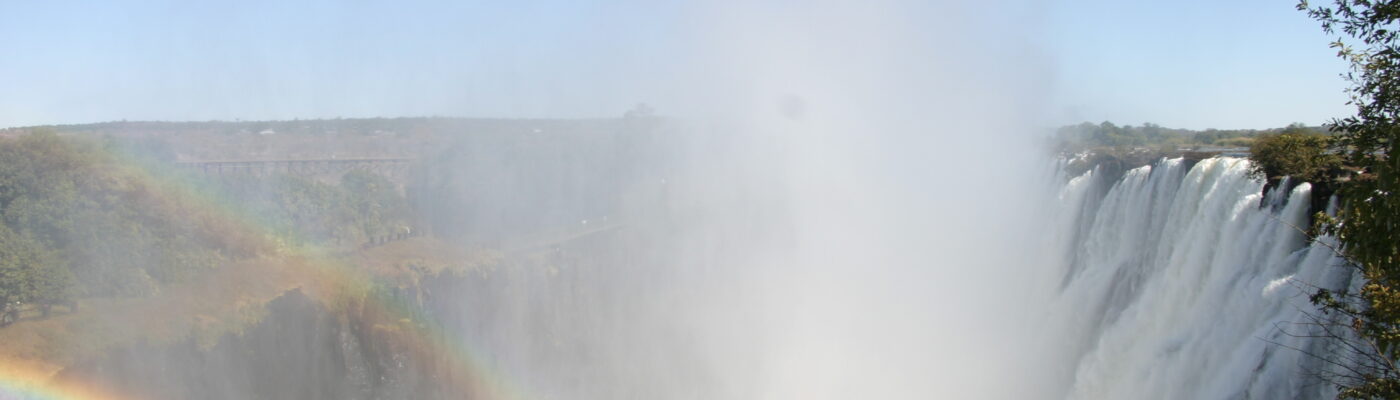
So after a 20Dollar entrance fee to the Mosi-ao-Tunya National Park, we followed a dirt path, past a bronzed statue of Livingstone (who stands pointing towards the Zimbabwean border) and around a corner. And there in all seven colours, were two rainbows suspended in the gorge.
I find that the most captivating characteristic about looking at a rainbow is the fact that it is transient by nature, and that any change both in the availability of sunlight or droplets in the atmosphere might change the scene. But here were two (in pure magnificence) which remained for as long as I stared.
Once a month, there is also a phenomenon called the ‘Lunar Rainbow’ or the ‘Moonbow’, which can be seen at night emerging from the spray instead of the usual daylight rainbow. This happens with every full moon and to cater for this infrequent display of splendor, the reserve remains open for the evening.
The thing about the Falls though is that it is so expansive that you need to walk at least half a kilometer along the reserve path, itself dotted with several observation points. Part of this path then led over a bridge, on which falls a continuous torrent of ‘rain’ (actually spray which is forced back up the 100 meter side of the gorge due to the force with which it hits the bottom). And so it was that I experienced ‘sunlight in the rain’ which produced a childlike delight, as if I were two again and had just stepped into the garden sprinkler. Laughing, wanting to do it again…I ran back across the bridge and was thrilled to giggles. To keep dry, we had been given plastic ponchos on entry: hooded garments which hid our identities well (thanks to their non-descript and unfitted style).
Regarding the reference to Mosi-Oa-Tunya then, it is the local name given to the Falls: the Smoke that Thunders. Unlike Western names, I would say that it is a lot more aesthetically accurate than the name given by Livingstone. And as the ‘smoke’ rises, significance lies in the fact that since they were first discovered, the Falls had not altered (even slightly). So like David, I had ‘discovered’ them (even if just for myself).
Livingstone: the town
Downtown: a local market was the only one of its kind and here, vendors sold wooden items, crafts and beads (similar to the merchandise we find on our beachfronts here in SA). The locals were thin and many seemed poor. Walking past a few stalls on Saturday afternoon, I was stopped and asked for the elastic band I had wearing around my wrist, as well as any pens (I might have in my bag). For these items, men were willing to trade beautifully hand-crafted wooden elephants. So as an aside: should you have the opportunity to travel to the country, take a few pens and elastics because if not to trade with, then to at least help meet the dire and prevailing need.
Back to the centre of the town though; there was a Spar, Steers and various other recognisable outlets (all of which seemed fairly deserted). Driving past unbranded bargain shops and clothing stores, we giggled at a ‘Fawlty Towers’ bed and breakfast; sign of the colonial footprint.
I suddenly craved a chocolate coated ice-cream from Steers, but was slightly saddened when both my dollars and Rands were denied. So take note: kwachas alone will buy you an ice-cream (chocolate or other).
The David Livingstone Safari Lodge & Spa: Resort
At the David Livingstone Safari Lodge and Spa, we stepped back into first class luxury and away from the streets, dined on gourmet meals; ordering numerous gin and tonics (as a preventative cure against malaria). Thus much like Mozambique, Mauritius, Kenya (and countless other countries) the first and third world discrepancies remained highly noticeable, but with the influence of the tourist industry (and foreign nationals bringing good currency into the country) the hope is that it will boost not only the local economy, but so too the life of the individual on the street.
The ‘colonial styled’ four-star David Livingstone is situated 5km from Livingstone, and 10km from Victoria Falls. So after our return from the falls and a decadent lunch at the Gwembe Terrace, we were then scheduled for a Saturday (sunset) cruise on the three-decker M.V. Lady Livingstone (at a cost of 5 US Dollars for the river fee for SADC residents and 10 US Dollars for International guests.)
Later that evening, dinner was served at the Kalai restaurant: a portion of tender, medium-rare meat infused with an unmistakable Afro-Arabian flavour. But I soon felt the chill of night and so after the meal, we headed to the ‘bonfire’ in-front of the Ujiji bar. Having joined a non-descript looking group, we soon realised that one or two happened to be dignitaries from parliament. Seated with them was the high commissioner of South Africa to Zambia and visiting from Scotland in a bottle: Johnnie Walker (the latter of whom produced the most stories and anecdotal memories).
Heading to my room about two hours later, I climbed into my King-sized bed, the linen softly turned down and my double set of doors opened onto the Zambezi. Surrounding the entirety of my bed, transparent curtains fell with a soft grace; there to guard against mosquitoes (of which there were only a few; thanks to this being the winter season).
To embrace the topic of malaria though, I had decided not to take pills and the plan was to simply be aware of any symptoms for up to two weeks after returning home. Theories always differ however, as others would rather dive deep into a bottle of prophylaxis. So whilst I forfeited the medication, I compensated by spraying myself continuously (and generously) with Peaceful Sleep, and by drinking many a tonic (as previously alluded to).
Lion walk
The next (Sunday) morning, it was a 6am wake-up call for our scheduled Walk with the Lions in the Mosi-Oa-Tunya National Park.
The African Lion & Environmental Research Trust (ALERT) works to promote awareness surrounding the slow, yet steady, disappearance of the African Lion. To give some figures: in 1975, over 200 000 lions roamed the African continent. In 2002, estimates then put the population between 23 000 and 39 000 (representing an 80-90% decline in less than 30 years). The numbers are still falling. I’m mentioning this simply because by participating in a Lion Walk, your fee will directly benefit the conservation of these Beasts.
From the age of three weeks then, the cubs are separated from their mother and hand-reared, giving them the opportunity to develop their natural instincts (on walks) in a wild and natural environment. When the cubs are older they are released (as a pride) back into the ‘semi-wild’, where they are then forced to fend for themselves. It is in this context that they later give birth to cubs of their own that (when old enough) will also be release ‘back’ into the wild. And so the cycle continues. It is during this early ‘pre-release phase’ then at which we encountered the lions, walking with them as if part of their pride.
On the logistical side, participants cannot be younger than 15 years of age or shorter than 1.5 meters (as the cubs are intimidated by height, and the converse applies). So on that crisp Sunday morning, one member of our group had decided to wear a skirt; which sadly disqualified her from the walk. So with regards to clothing: be sure to wear pants, as skirts or any other dangling attachments might attract an unwanted swipe of play from the lion (very unlike the gentle tap of a kitten).
So with jeans and a whispy stick for protection, I headed out to enjoy 45 minutes of controlled interaction with these otherwise (wild) animals, my mind entertained with flash-backs of the 1966 British drama, Born Free. All I needed was for someone to yell ‘Else’…and I would have giggled.
At this same reserve, we also had the privilege of encountering (and feeding), what had been abandoned and orphaned elephants, now fully grown. Behind us and on the banks of the Great Zambezi, crocs came out to sun themselves, lying ominously still and camouflaged. On the opposite bank too, a mother and baby hippo fed off tufts of green. This was the Eden of Africa!
On Sunday afternoon…I was sad to leave!
And as I landed in Cape Town I stared at a yellow advert, glaring and garish. It was then that I realised I had ‘detoxed’ in a matter of two and a half days: no pop music or culture, not many lights, no sirens. It felt strange, as if a time-bubble had spat me back into GMT: rushed and fast paced.
As for Livingstone, it dances to a different beat and adheres to a different concept of Time and Space, of Respect and Authority. Not east and not necessarily west, it evades both polarities as well as sometimes the ‘universal judgments’ based on the understanding of opposites: East and West, right and wrong, black and white, fat and thin. In Africa though, these divisions fall by the (dusty) wayside and it is then that you realise that there is that shadow of ‘something in-between’, where fat might just be right, and white may just be black (depending on what time of day you’re making the judgment call). And whilst many have been trying to change, colonise and tame Africa, I also appreciate the fact that she is Beautiful in her ‘Imperfection’: where Time may not be told on a clock but by the change in taste of a stewing piece of meat…where it is divided not into minutes or hours, but into conversations with neighbours.
Africa.
And for a brief weekend, Livingstone imprinted a sense of what it meant to be African.